

Follow the steps
Boards are the lessons you teach
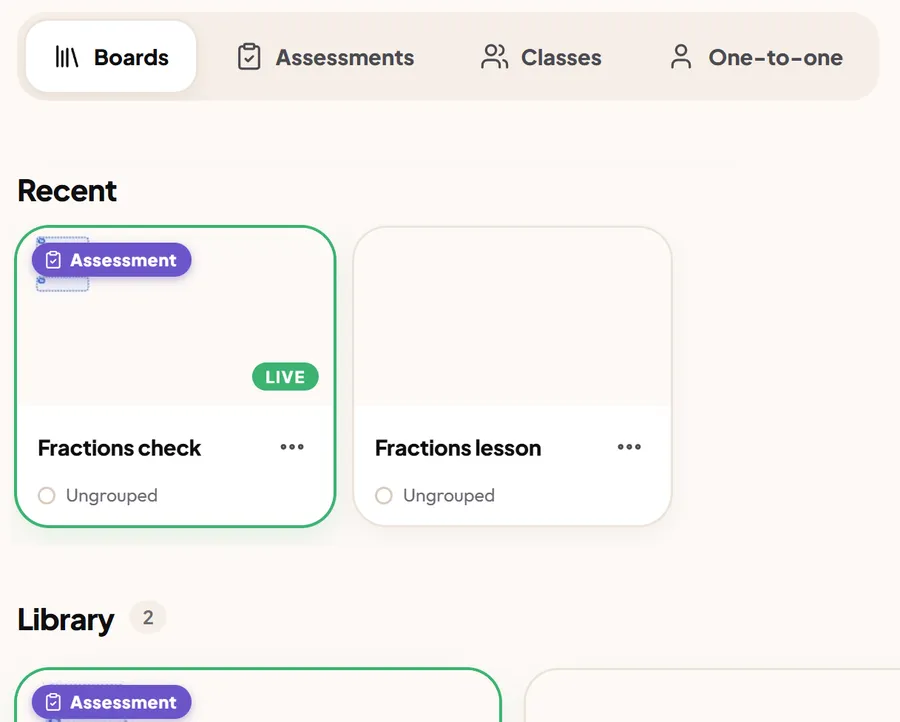
A board is a lesson. It holds your pages, your answer boxes and anything you draw. There is no go-live button: the board you have open is the lesson your pupils join. Boards you want to reuse live in your Library, and a Library board is never live by accident. Choose Use in a lesson to teach from a fresh copy.
Assessments are timed, with a mark scheme
An assessment is not a lesson. You set the marks for each question, and you can give marks for method too. Pupils sit it with an optional timer. Answers and help stay hidden while they work, and they see their score only when you press Release results. See how assessments work.
Classes keep your pupils together
A class holds a group of pupils. You find your classes in the Tuition hub. Boards and assessments can be linked to a class, so everything for that group is in one place. Class lists are optional. Jotoro works from your very first lesson without one.
One-to-one is a single pupil
A one-to-one pupil has their own page, just like a class. Use it for tuition, catch-up work or a pupil you see on their own. One assessment can go to many pupils at once.
Homework has its own section
Homework is not a lesson and it is not a board pushed at pupils. It has its own tab along the top of the home screen, with its own due date. You set it from any board, a Library card, a class page or a one-to-one page, then mark it when pupils hand it in. Pupils can open their homework from home as well as in the room.
Good to know
- New to Jotoro? Start with a board. You can add assessments, classes and homework when you need them.
- Not sure which one to use? If you will teach it live, make a board. If it needs a score, make an assessment.
- Pupils do not need to be at school to do their homework. They can open it from home.
Common questions
What is the difference between a board and an assessment?
A board is a lesson you teach, live with your class. An assessment is timed and has a mark scheme. Answers and help are hidden while pupils sit it, and they see their score only when you release results.
What is the difference between a class and a one-to-one pupil?
A class holds a group of pupils. A one-to-one pupil is a single pupil with their own page. Boards and assessments can be linked to either.
Do I have to set up classes before my first lesson?
No. Class lists are optional, so Jotoro works from your very first lesson.
Where does homework live?
Homework has its own tab along the top of the home screen, next to Boards, Library and Assessments. It has its own due date.
Can pupils do homework from home?
Yes. Pupils open their homework from home with the class link, their name and their PIN.
Related guides
How to get started with JotoroGetting startedHow to find any tool with Quick findGetting started How to choose your pen, ink style and page backgroundGetting startedHow to start a live lessonLive lessons
Cannot find an answer?
Tell us what was missing and we will improve this guide.
Suggest an improvement