A quick note before we start. If you are looking for the how-to of running a lesson with children on a call, read how to teach a group of children online. This post is a step back from that: how to design a small group, plan for it and make it work for the children and for your business.
How big should a small tuition group be?
Think of it as a test rather than a number: can you look at every child’s work during a ten-minute task and say something specific about each? If you can, the group is the right size. If you are only skimming, it is too big.
For most tutors that lands between three and eight. With three or four you get real conversation, and every child gets a lot of you. With six to eight you get energy and children learning from each other, but you need good habits to keep track.
It is tempting to add one more pupil when a family asks. Resist it unless you are sure the lesson will hold. A group that is too big loses its best feature, and the families notice before you do.
How do you plan for mixed ability?
Almost every small group is mixed ability, however carefully you set it up. Children who started level drift apart in a few weeks. The answer is to plan for the spread from the start and not to be surprised by it.
Plan every task in three layers. The core is what most of the group should be able to do. The way in is a smaller first step, a hint or a worked example, for the child who is stuck. The extension is a question that is a little harder rather than just longer, for the child who finishes early. Have the extensions ready before the lesson. Finishing early and sitting idle is the quickest way to lose a keen child.
When you form groups, start with the next step each child needs, not their age. Two children in the same school year can be a topic apart. Two children who need the same next step can work happily together even if they are two years apart. Check the groups every half term and move children when they have outgrown them. Families are generally grateful when you do.
What does a good group lesson look like?
A good small-group lesson has a rhythm that alternates between you and the children, and between the group and the individual.
A small group lesson in five steps
- Start together. One question on the page for everyone as they arrive, so the lesson begins on time.
- Teach one idea. Show it once, briefly, with one worked example.
- Everyone tries. Each child works on their own page. You look across all of them before you help anyone.
- Respond at the right size. If most are stuck, teach it again to everyone. If a few are stuck, sit with them. If it is one, go quietly to that child.
- Finish together. One last question each, then two lines for yourself about who needs what next time.
The habit that makes the biggest difference is looking across the group before you help anyone. It tells you whether you have six wrong answers or one wrong idea, and those need different responses. Choose one piece of work and put it in front of the group, with the child’s permission and with names left out if you prefer. Children learn a lot from a method that is not theirs.
What makes group tuition work as a business?
Whatever you charge, group tuition makes sense when the lesson is better for each child than they could get any other way at that price. It is not a cheaper version of one-to-one. It is a different offer, with its own strengths: other children to learn with, a regular time in the week and a tutor who knows the whole group.
Think about the sums in terms of your own time, not just income. A group lesson takes about the same planning as a one-to-one, but the planning is shared by several families. The marking and the records are shared too, if you have a good way of handling them. That is the point at which a group starts to pay for itself, as long as the quality of what each child gets does not fall.
Three things protect that quality. Keep the group size under control, so every child is seen. Keep your planning light and reusable, by building a lesson once and running it with each group at that level. And keep a clear, short record for each child, so you can tell a parent exactly what their child did and what is next. Parents stay when they can see progress, and they stay for the tutor who can show it.
If you run a tuition centre with several tutors, the same ideas apply across the whole team. A shared bank of lessons and a consistent way of recording progress mean a family gets the same quality whichever tutor teaches the group. Pricing is your call, and we do not tell you what to charge, but our own plans are on the pricing page if you would like to see how they work for a team.
How does Jotoro help with small groups?
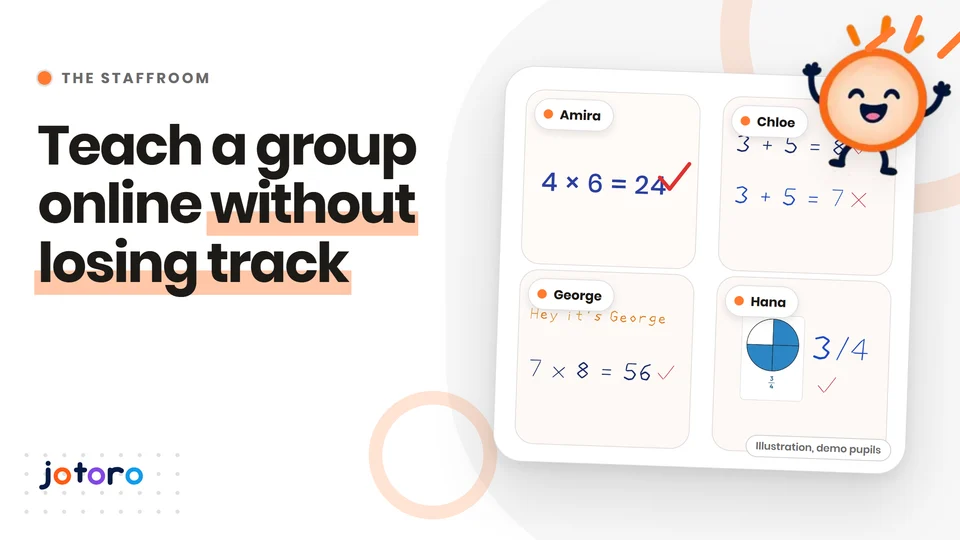
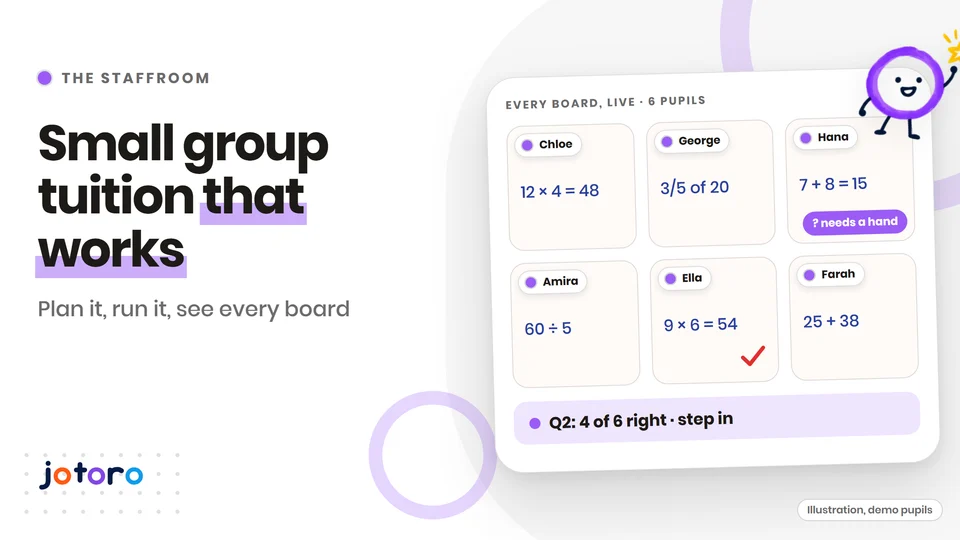
Every child gets their own board and you see all of them at once, as they write. It is the nearest thing to standing over six children’s shoulders at the same time.
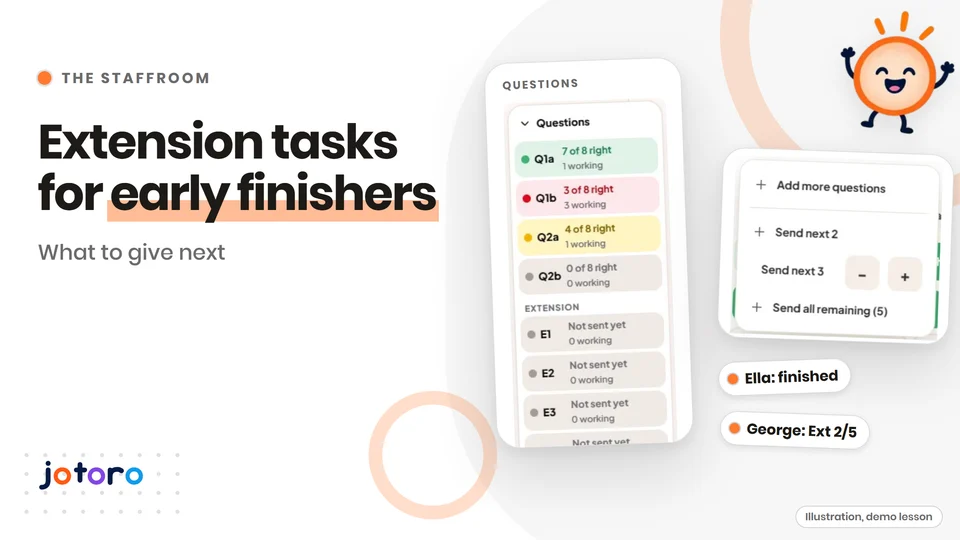
When you put answer boxes on a worksheet, a slim strip down the side of your board lists each question with how many pupils got it right, in green, amber or red. That tells you straight away whether to reteach to everyone or sit with one child. You can step onto any board and mark in red while the child watches. Prepared extension questions can be sent to early finishers in twos, without stopping the lesson, and Jotoro remembers who has done which.
You can spotlight one child’s board so everyone sees it, or put two side by side to compare methods. Children join with a permanent class link and a waiting room means nobody unexpected gets in: you see who is waiting and let them in. Everything that happens is logged per pupil, lesson by lesson, so the record builds itself. To manage several students at once during online tuition, give each one their own board and send the same page to everyone, as described in a whiteboard for group tutoring.
What should you keep track of?
Less than you think. For each child, note who needed help, what they found hard and what to open with next time. For the group, note the question that tripped most of them up. That is your starting point for the next lesson, and it is enough to tell a parent something real.
If you want the one-to-one side of the picture, see one to one tuition online. For quick ways to check what each child understands, see formative assessment in live lessons. You can register interest to try Jotoro if you are a tutor, and plans and prices are there when you want them. There is a 14-day money-back guarantee.