What is formative assessment, in plain words?
It is checking what children understand while the lesson is still happening, so that you can change what you do next. That is the whole idea. It is not a test, it does not need a grade, and a good one can take under a minute.
The difference from marking is timing. A test at the end of a unit tells you how it went. A quick check in the middle tells you whether to explain it again, move on, or hand a different task to one child. A check is only worth doing if you are willing to act on the answer.
Underneath everything that works there is one habit: every child commits to an answer before they see anyone else’s. Hands up lets the quickest child answer for the whole room. When everyone writes, holds up or types an answer at the same moment, you learn about the whole group, including the child who would never have put a hand up.
What are the best formative assessment ideas for a live lesson?
None of these needs special equipment. Pick one or two and use them every lesson until they feel natural.
- Questioning. Ask the question, give thinking time, then ask everyone, not volunteers. “How do you know?” and “What would happen if…?” tell you much more than “Is that right?”
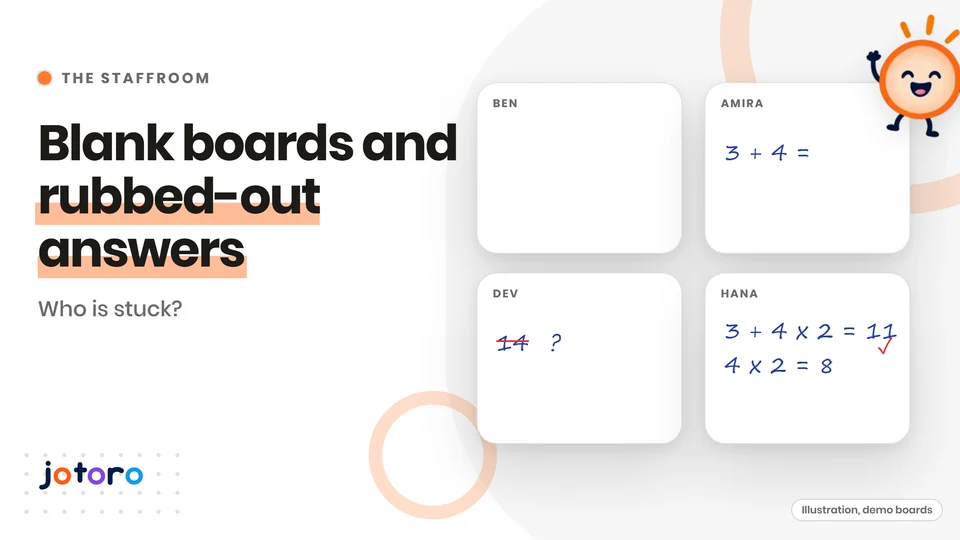
- Mini whiteboards. Everyone writes an answer and shows it at the same moment. You see the whole room in a glance. It works online too: see online mini whiteboards.
- Hinge questions. One multiple-choice question, written so that each wrong answer points to a different misunderstanding. If a child picks B, you know which idea to mend. Write it before the lesson, at the point where the lesson could go either way.
- Exit tickets. One or two questions in the last few minutes: what was clearest, what is still muddy? Read them before you plan the next lesson.
- Polls. A quick show of opinions or predictions before you reveal anything, for example “Which will float?” before an experiment. Children who guessed wrong are often the ones who then listen hardest.
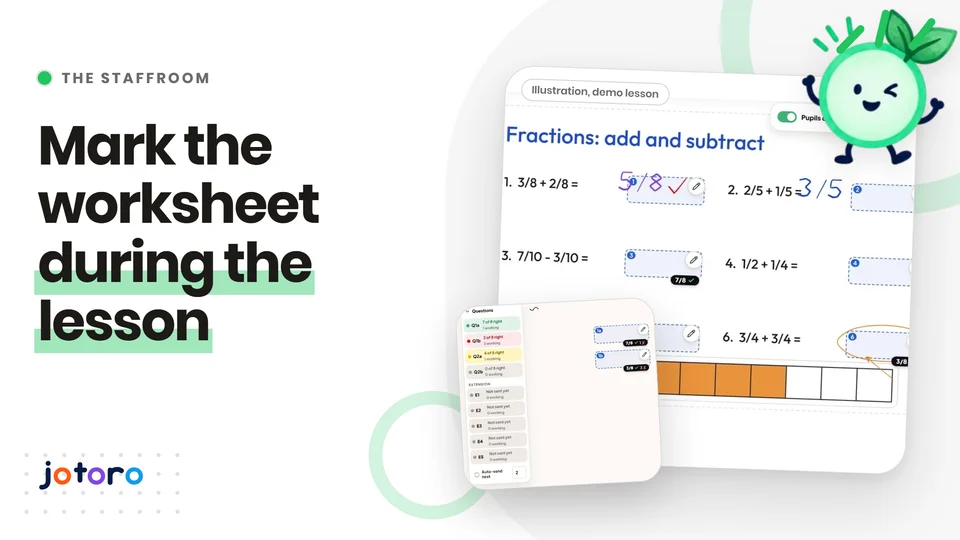
- Live marking. Look at answers as children write them and respond at once. The routine is in how to mark a worksheet during the lesson.
A formative check in five steps
- Decide what you need to know before you ask. One idea per check.
- Give thinking time, then everyone answers at once.
- Look at the question across the group before you look at any child.
- Choose your response: whole class, small group or one child.
- Jot down who needed help, in a line. That is next lesson’s starter.
What do you do with what you find, in the moment?
This is the part that makes it formative, and the part most often skipped. Think of three sizes of response.
The whole class. If most of the group gave the same wrong answer, you do not have six wrong answers, you have one wrong idea, and it may be one you have not taught well yet. That is useful to know. Stop, say the common wrong answer aloud without names, ask why somebody might have chosen it, and teach that one idea again.
A small group. If three or four are stuck in the same place, send the rest on and sit with them for two minutes.
One child. If it is a single child, go to them quietly. Fix it in their own writing and leave them to try again.
The children who finish early are information too. Have a couple of extension questions ready, a little harder rather than simply more, and give them out in twos so nobody races through the lot.
One more habit: tell the class what you are doing. “I am looking at question four, not at you” takes the sting out of being checked. Children share their thinking, wrong turns included, when they trust that it is a conversation about the work and not a verdict.
How does formative assessment work online?
Online is harder, because you lose the glance across the room. A camera shows you a face, not a page, and a child can look busy for ten minutes while writing nothing useful.
There are plenty of ways round it without special tools. Ask for answers in the chat, and wait for “go” so nobody copies. Have children hold a mini whiteboard up to the camera. Use a shared document with a column for each child. All of them beat hands up, and all of them cost you some scanning, which gets slower as the group gets bigger. The aim is the same as in a classroom: see the work, not just the person.
How does Jotoro help with formative assessment?
A camera cannot show you the work. In Jotoro every child has their own board, and you see every board live as they write. It is the nearest thing to walking round the room, and you can step onto any child’s board and mark in red without stopping anyone else.
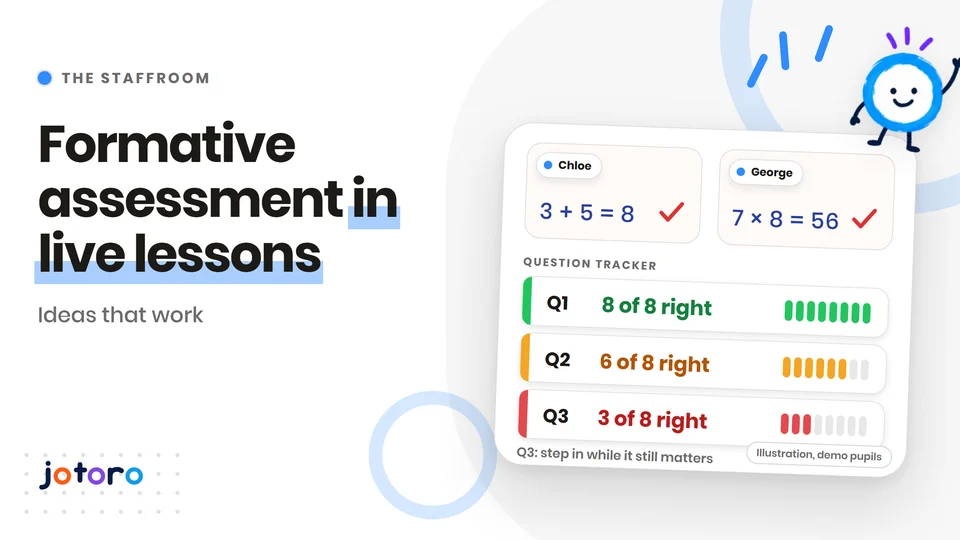
Every question you set also works a bit like a live poll. Put answer boxes on a worksheet and a slim strip down the left of your board lists the questions, each one showing something like “6 of 8 right” in green, amber or red. You can see at a glance which question the class is stuck on, and which topic you have not taught well enough yet, and step in while it still matters.
What is worth keeping afterwards?
Not everything. Keep the three things that will change your next lesson: the question most children got wrong, the children who needed help twice, and anything that surprised you. In Jotoro, answers, stars and your own notes are logged lesson by lesson, so the record builds itself and you spend your time on the next step.
Then use it. Open the next lesson with the question that tripped them up, in a slightly different form. It tells the class that mistakes are useful, and it tells you whether the fix stuck.
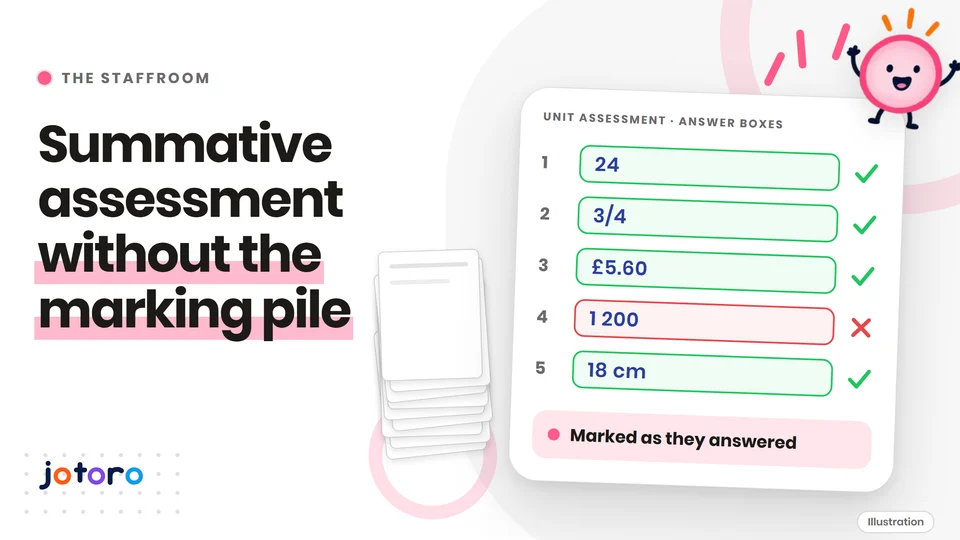
Formative checks are for steering. When you need a proper paper with a mark scheme, that is a different job, and we cover it in summative assessment without the marking pile. To see how marking and results fit together in Jotoro, see marking and assessment. For checks that suit particular subjects, try science teaching ideas and history and geography teaching ideas. You can register interest to try Jotoro on your own worksheet, and plans and prices are there when you want them. There is a 14-day money-back guarantee.