Why a face tells you so little
In a classroom you notice things without trying. Chloe’s pencil stops. Dev’s chair goes quiet. Online, all of that disappears into small squares. A child who is stuck looks exactly like a child who is thinking. A child who has switched off looks exactly like a child who is listening.
So you ask the question every online teacher has asked: “Is everyone all right?” Four heads nod. They would nod either way.
The fix is not to stare harder at faces. It is to look at something each pupil has written. A page tells you things a face never will. Here are five signs worth knowing, and what to say for each.
Sign 1: a blank board
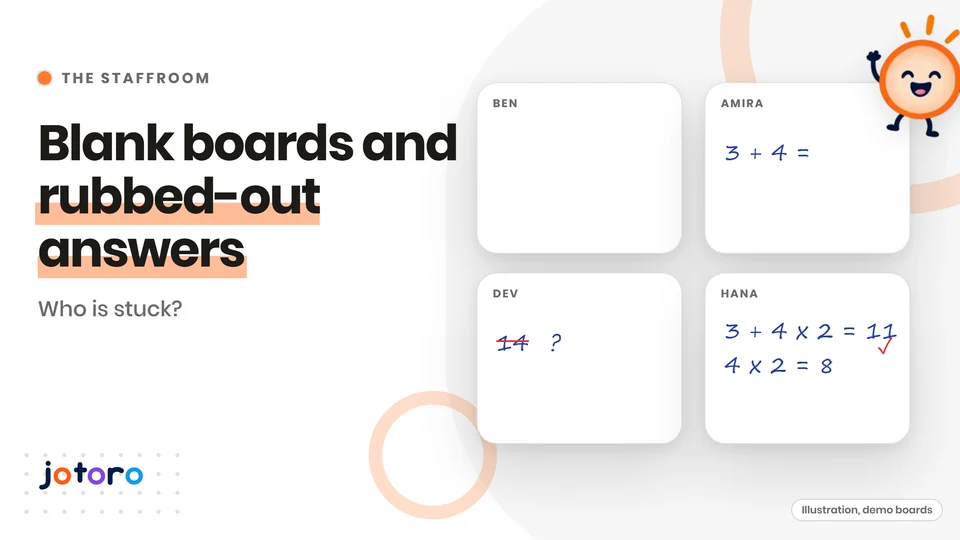
Two minutes after you set the task, Ben’s board is empty.
It can mean several things. He has not understood the question. He has understood it and does not know where to begin. He is embarrassed to say so. Or he is looking for the page.
Do not say, “Ben, you have not written anything.” Say, “Ben, shall we do the first line together?” Then write the first line with him, and hand the pen back.
A blank board is the easiest sign to spot and the quickest to fix, because the help is small: just a start.
Sign 2: a line that stops halfway
Amira has written three lines of a method. The fourth line is half a sentence, and nothing has moved for a minute.
That is a wrong turn at one specific step, and you can see which. It is a different problem from the blank board. She knows how to begin. She got to a place she did not recognise.
Point at the last good line, not the stuck one. “I like how you wrote that. What is the next thing you would do to this?” Pupils often finish their own sentence once they hear it said back to them.
Sign 3: an answer written and rubbed out
Dev wrote an answer, rubbed it out, wrote another, and rubbed that one out too.
This pupil is not lost. He is unsure, and he does not trust his own working. He needs a different kind of help: not a new method but permission. “Put your first answer back. Tell me why you chose it.”
Often his first answer was right. If it was not, you will both see where the thinking went wrong, which is more useful than a correct answer produced by guessing.
Sign 4: the same slip on three boards
Chloe, Ella and Hana have each written 3 + 4 × 2 = 14.
That is not three pupils’ mistakes. It is a gap in your explanation, or a trap in the question, and it belongs to you to fix. Better still, you have found it while the lesson is still running.
Say it to the whole group, without naming anyone: “A few of you wrote 14. Let us look at the order we do things in.” Then work one example together, and let them try again.
Spotting a shared slip is the real benefit of seeing everyone’s work at once. It is the difference between teaching eight pupils and teaching one pupil eight times.
Sign 5: a full page, done early
Hana has finished. Her page is full, her answers are tidy, and she is looking at the ceiling.
This is not a problem, but it is a sign. Pupils who are finished quickly become pupils who are bored, and bored pupils become the ones who wander away from the lesson.
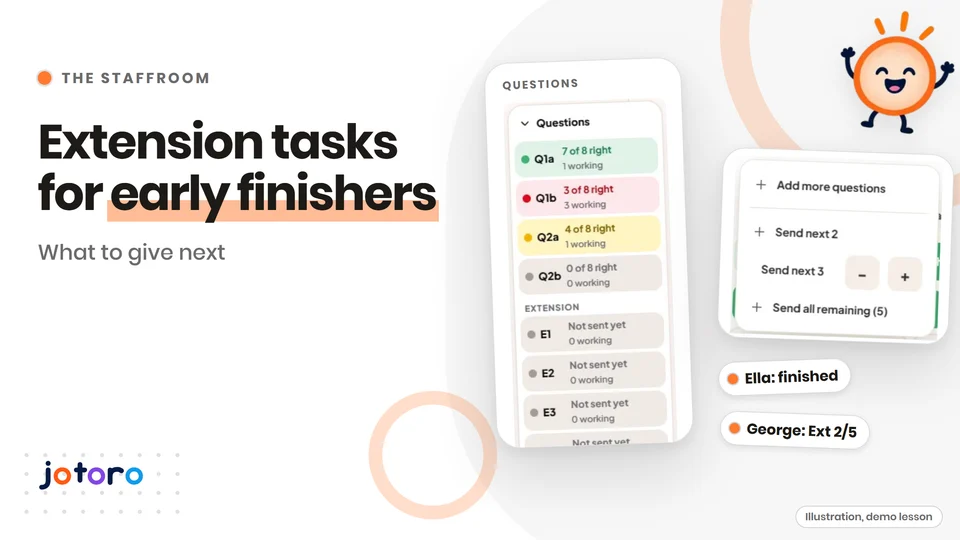
Have something ready. A harder question, a “now explain why” or a “now make up one like it for the next pupil”. Our post on extension tasks for early finishers has ideas.
Make it a habit
None of this works if it is a hunch you have once. It works if it is a habit.
Every time you ask for writing, give it a short, fixed glance and run down the five signs. Blank, stopped, rubbed out, same slip, finished. Then speak to the pupil who needs you, kindly and privately where you can.
A short, steady glance beats a long, anxious stare. If checking takes more than half a minute, you will stop doing it by the third lesson.
Seeing every page at once
You can do this with paper held up to a camera, one pupil at a time, but you are guessing about everyone else. You can do it with separate pages in a shared document, but you flick between tabs.
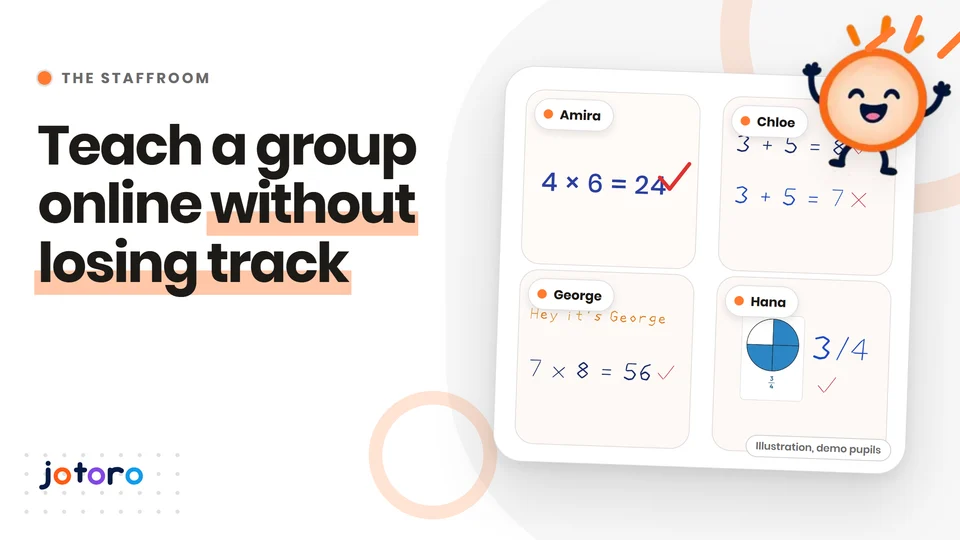
In Jotoro, every pupil has their own board, and your screen shows all of them side by side while they write. You see Ben’s blank board and Amira’s half sentence on the same screen, and you can step onto either one and write in red while the others carry on.
“I think this activity in particular is quite useful, because normally you’d have to do formative assessment with the class one at a time, whereas this one, you just let them do it, and then you can actually just see it from your point of view.”
Read more on seeing every pupil’s whiteboard at once. If you are new to teaching a group online, start with how to teach a group of children online without losing track, and see the live classroom for the whole picture.
Payments are not open yet. Register interest and we will tell you the day they do. Pupils are always free.