History, geography and RE lessons share a problem. The ideas are big, the material is wordy, and a class discussion is usually carried by the same four pupils. The ideas below are all ways of getting every pupil to do some thinking you can see.
How do you teach source analysis and map skills?
A source is easy to read and hard to question. Many pupils summarise it, when what you want is for them to use it as evidence. The fix is a small set of questions, the same every time, so pupils stop wondering what is being asked.
Five questions for any source
- What is it? A letter, a poster, a photograph, a map, a graph.
- Who made it, and when? Is it from the time, or looking back?
- Why was it made? To inform, persuade, record or sell.
- What does it tell us? Point to the part that says so.
- What does it not tell us? What would we want to check against another source?
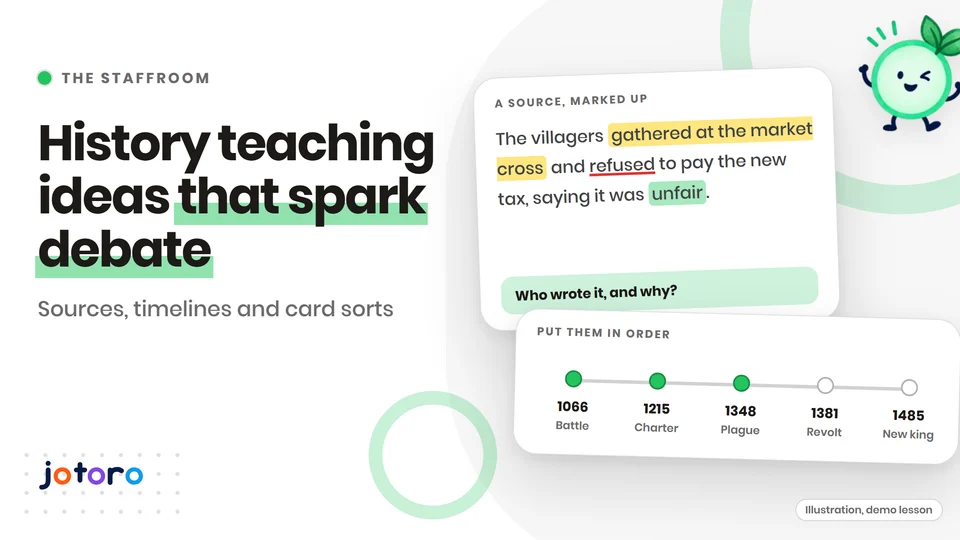
The step that changes the quality of answers is the fourth one. Ask pupils to mark the exact words or part of the picture that gave them each answer. Then “the poster shows the government was worried” has a circled phrase behind it, and you can see at a glance whether the phrase actually says that.
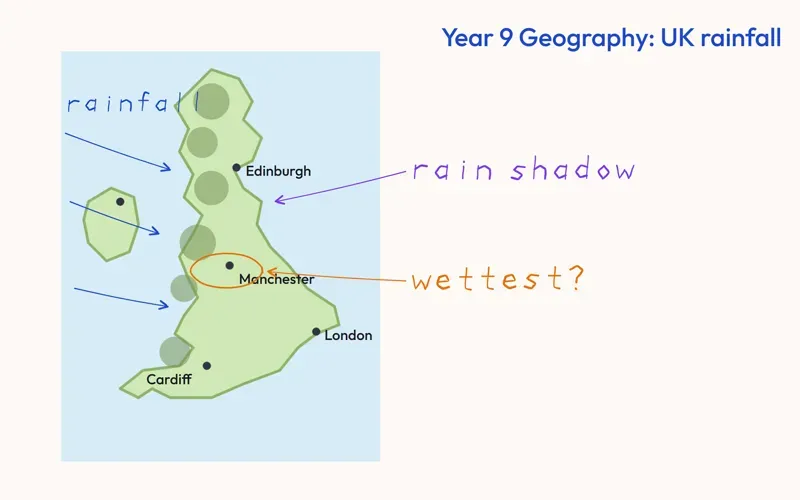
Maps work the same way. Give pupils a blank or lightly labelled map and ask them to draw on it: trace a route, circle the wettest place, shade the area an empire controlled, add an arrow for the prevailing wind. Drawing on a map makes pupils decide, and a decision is a good thing to talk about. A map copied from a textbook shows you nothing about whether they understood it.
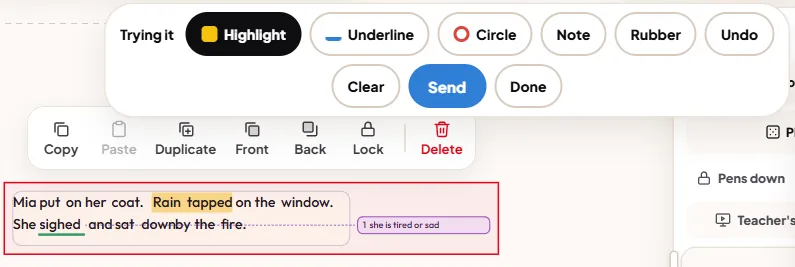
In Jotoro you put your own source or map on the board, whether it is a text, a picture or a PDF page, and every pupil gets their own copy to mark. The pen works on any of them. For a text, comprehension annotation gives each question its own colour, so Dev’s evidence for question 2 stays with question 2. You can put two pupils’ copies side by side and ask the class what is different. Jotoro does not include maps, so the map is always your own.
How do you teach timelines and chronology?
Pupils can recite dates and still have no feel for the order of things. A good timeline activity makes them place events, not copy them.
- Order the cards. Give each pupil five or six events on cards in the wrong order. They put them in sequence, and you ask which one was hardest to place and why.
- Add the gaps. Once the order is right, ask what happened between two events. A pupil who can say how one battle led to the next has understood more than one who has memorised the dates.
- Spot the odd one out. Slip in an event from a different period. Pupils who spot it have a sense of the shape of the topic.
- Zoom out. Ask where this period sits against what pupils learned last term. Connecting timelines is how a pile of topics becomes a story.
Start with fewer cards than you think you need. Five events with large gaps between them are a fair first test, and six events within the same decade are a hard second one.
On Jotoro, you make a timeline with ordered slots and sort and sequence cards. Each pupil sees the cards shuffled their own way, drags or taps each one into place and finds out whether their placing was right. The right order never appears on a pupil’s screen. You see who has it and who is stuck, so Amara’s board with Trafalgar before Hastings stands out at once. There is no separate timeline tool, so you build it from the cards.
How do you use card sorts in history, geography and RE?
A card sort asks pupils to decide where something belongs. The talk comes from the decisions that are not obvious.
- Causes and consequences. One column for causes and one for consequences, with a mix of cards. The ones pupils disagree about are the interesting ones.
- Short term and long term. A second sort of the same cards. Pupils quickly learn that one event can sit in more than one place.
- Physical and human. In geography, sort features of a place, such as river, farm, factory and road, into the groups pupils think they belong to.
- Viewpoints. In history and RE, give pupils quotations and ask which view each one supports. It teaches them to read for the argument, not the topic.
- Venn and Carroll sorts. For comparing two periods, two places or two beliefs, where some things belong to both.
Finish by asking one pupil to explain a card they nearly put somewhere else. That is where the thinking is.
Jotoro has Venn and Carroll sorts and column sorts, and pupils can also join cards with arrows to show that one thing led to another, with the direction checked. Each pupil works on their own copy, so you see every sort as it is made, not only the one you pick.
How do you run a debate that everyone joins?
Debates in humanities lessons often go wrong in the same way: a few confident pupils speak, and the rest wait for it to finish. Make everyone commit first.
- Ask a question with two honest sides. “Was the Industrial Revolution good for ordinary people?” or “Should a new motorway be built here?” or, in RE, “Can a person be good without belief?”
- Vote. Every pupil chooses a side before anyone speaks. Now nobody can drift.
- Give evidence time. Pupils find one reason from a source, a map or last lesson.
- Talk, then vote again. Did anyone change their mind, and what moved them? That second question is worth more than the debate.
Ask pupils to argue the side they did not choose for a minute. It is hard, and it shows whether they understand the other view.
In Jotoro you run a live poll: pupils answer on their own devices and the spread appears on the board. Pupils see only the bars, never names, so it is safe to show the class, and you choose when to reveal. Run it again after the discussion and see how the bars moved. An exit ticket at the end shows who left with the idea.
How do you use video clips well?
A clip played from start to finish is easy to switch off from. A clip you stop on purpose gets pupils thinking.
- Give a job before you press play. “Find two things that show how people lived.”
- Pause on a still. Ask what pupils see, then what they think it means, then what makes them say so. That is source analysis again.
- Play it without sound. Pupils describe what is happening, then watch with sound and compare.
- Keep it short. A two-minute clip with a good question beats ten minutes without one.
On Jotoro you put a video clip on the board, then pause it and write on top while the class looks. Circle a detail in the frame, draw an arrow, or ask pupils to do the same on their own copy of a source beside it.
How do you get the most out of your humanities lessons?
The tools matter less than the habits. These work in any history, geography or RE lesson, with or without Jotoro.
Six habits for better humanities lessons
- Ask the same source questions every time. Routine frees pupils to think about the content.
- Point to the evidence. Every claim gets a circled phrase or a marked place on the map.
- Order before you explain. Let pupils try the sequence first, then talk about it.
- Sort, then defend. One pupil explains the card they nearly put somewhere else.
- Vote before you talk. Then vote again to see what moved.
- Stop the clip. Pause on a frame and ask what pupils notice before you tell them.
Notice that none of these take extra marking. They take a little planning and a habit of looking at what pupils produce while they are still in the room. That is the idea behind formative assessment in live lessons, and the same close-reading habits matter in English teaching strategies.
If you want to see how the whole subject fits together, Jotoro for humanities shows each activity on the board. You can register interest to try it. There is a 14-day money-back guarantee, and plans and prices are there when you want them.