Most of what makes an English lesson work has not changed in years: children talk about language, try things out, get it wrong in a safe place and see good writing being made. The trick is getting more of that into each lesson. Here are five strategies that do, each with a note on how it goes with or without Jotoro.
How do you teach sentence structure and punctuation?
Start small. A child who cannot yet control one sentence will not control a paragraph, and sentence-level work is quick enough to fit into the start of any lesson. Three routines are worth having.
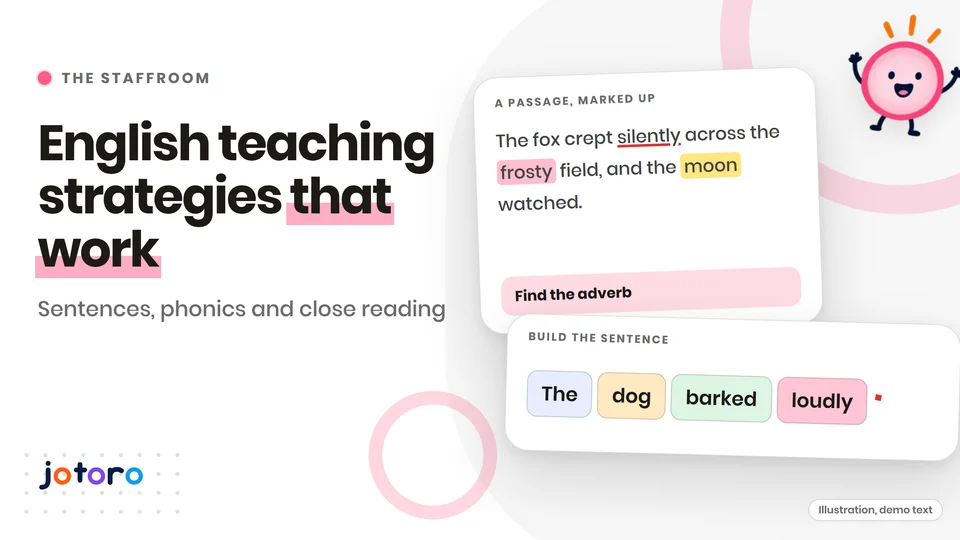
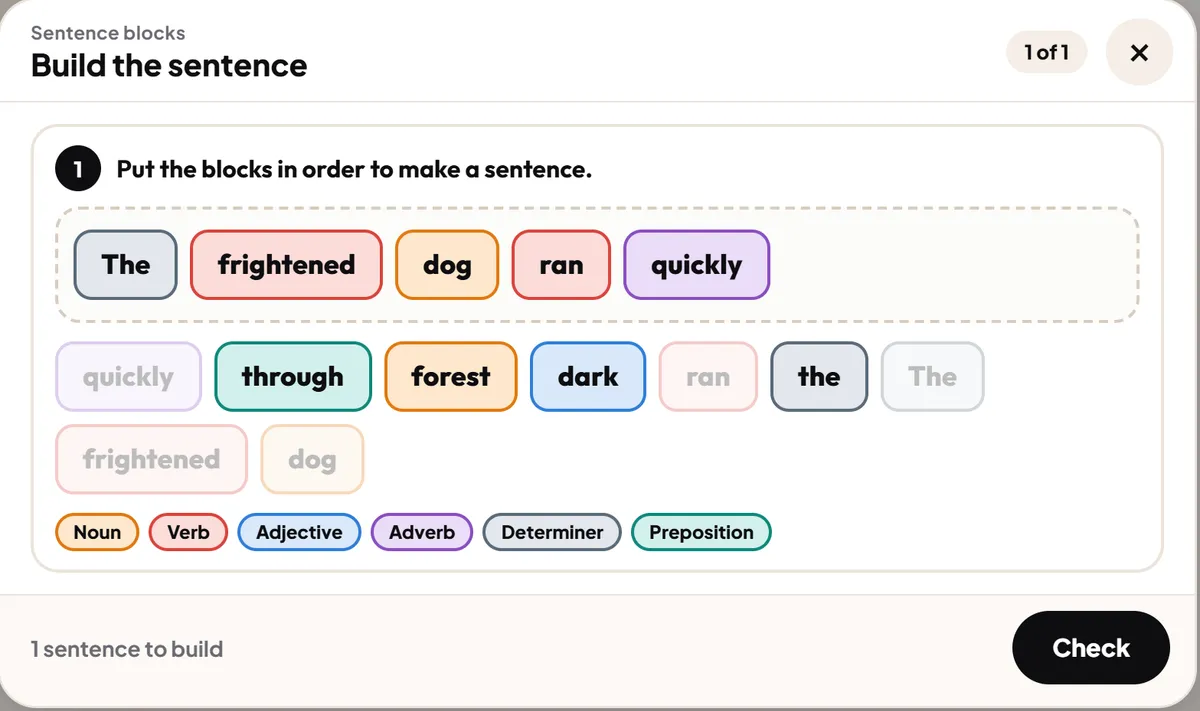
- Build it. Give the words of a sentence in the wrong order, or a pile of word cards, and ask for a sentence that makes sense. There is usually more than one right answer, which is the point.
- Expand it. Start with “The dog ran.” Ask for two more details: what kind of dog, and how did it run? Then ask which word they would swap to make it scarier.
- Repair it. Write a sentence with the punctuation and capital letters removed and ask children to put them back. Then ask each one to say why.
Talk about word classes as you go, because that is what makes the grammar useful. “Which word is doing the action? Which one tells us how?” Children who can name the job a word is doing find it much easier to move it around.
On a board, Jotoro’s sentence blocks do the building. Words are coloured blocks by word class, so a noun looks different from a verb, and pupils drag them into place. You can ask them to build a sentence, expand one, join two with a conjunction, or change one. Leo drags a full stop to the wrong place and you see it as he does it, so you can ask him, quietly, “Where does this sentence actually end?” Punctuation repair works the same way: you type the correct sentences once, pupils get them with the punctuation off, and they drag marks back into the gaps, with speech marks if you are working on direct speech.
How do you teach phonics to younger children?
Phonics rewards a brisk, regular routine: say the sound, see the letters, build the word, read it back. The three things to keep hold of are that children should hear a word before they see it, split it into its sounds before they spell it, and be asked to change one sound at a time (ship, shop, chop) so they see how the system fits together.
A five-minute phonics routine
- Say the word. Children listen, with no letters in sight.
- Split it. One sound at a time: s-h-i-p is three sounds, not four.
- Build it. Choose the letters or letter groups for each sound.
- Change one sound. Ship becomes shop. What changed, and where?
- Read it back to a partner, then use it in a sentence.
Jotoro’s phonics builder gives each child tiles for the letter groups (sh, ch, th, ai, igh and more) and a box for every sound. You can ask them to split a word, build one from tiles, with a few wrong tiles mixed in, or change one sound in a chain. A dot marks a single letter and a bar marks a group of two or three. The sounds and words are spoken from your device, so the class hears them through your speakers or your call, and the answer is not sitting on their screens. Picture-based phonics is not included, so if you want children to match a picture to a word, you will use your own cards for that.
How do you teach close reading?
Close reading is slow reading with a job to do. The mistake is to ask for everything at once, so give the pencil one task: underline the word that tells us how she feels, circle the clue, highlight what changes between paragraphs. Then ask for the reason, which is where the teaching is.
A good pattern is to mark first and talk second. Everyone marks their own copy in silence for two minutes. Then you ask, “Who marked something different from their partner?” Disagreement is where the reading happens. For comprehension questions, use a colour for each question, so the evidence for question two stays with question two and is easy to find when it is time to write the answer.
Jotoro lets every pupil mark their own copy of the same text, with highlight, underline and circle, and the marks snap to whole words. Use a passage you type in, a PDF page or a scan. With mark the word you choose the right word or phrase and the board checks what each child marked. With comprehension annotation the questions sit beside the text, with margin notes and a colour for each question. You see every child’s page as they mark, so Amira circling the wrong clue is something you spot in the lesson and talk about there and then. Later you can put two annotated copies side by side and let the class say which reading is better supported.
What is the best way to teach spelling?
Retrieval. Children remember a spelling when they have to pull it out of their memory, not when they copy it from a list. So the weekly routine matters less than the shape of it: few words, tested quickly, tested again later, and with the words each child gets wrong put back in front of them.
- Look, cover, write, check. The classic, and still good, as long as the cover step is real.
- Test, then test again. A short test on Friday, the same words in two weeks’ time, and the tricky ones again after that.
- Teach the pattern. If five words go wrong in the same way, teach the rule or the exception, not the five words.
- Keep a list per child. The words they keep missing are the whole of their spelling plan.
In Jotoro, make a word list once and use it several ways: a spelling test, look-cover-write-check, missing letters, unscramble, a word search, a crossword or a gap-fill. The test is read aloud from your device, so the class hears each word through your speakers or your call, while pupils see only the word number. When it is over you get a list of the words the class got wrong most often, and each child’s tricky words go into their record, so next week’s list nearly writes itself.
How do you give feedback on writing as children write?
The best moment to help a writer is while they are writing. Feedback on an essay a week after it was written arrives when the child has moved on. So make writing short, make it often and respond while the pen is moving.
Three habits make the difference.
- Model it. Write the opening of a piece in front of the class and say what you are thinking: “I want a stronger verb here. Walked is dull. Crept? Stomped?” Children hear how a writer decides.
- Share it. Write the next bit together. Children offer lines, you decide with them which is best and why. This is the bridge between your writing and theirs.
- Then let them write, briefly. Ten minutes, with a clear aim (“two sentences that use a conjunction and one that starts with an adverb”). While they write, move round and say one thing to each child.
The “one thing” matters. Pick the most useful point, not every point. A tick and a long comment tells a child less than a sentence said at the right moment.
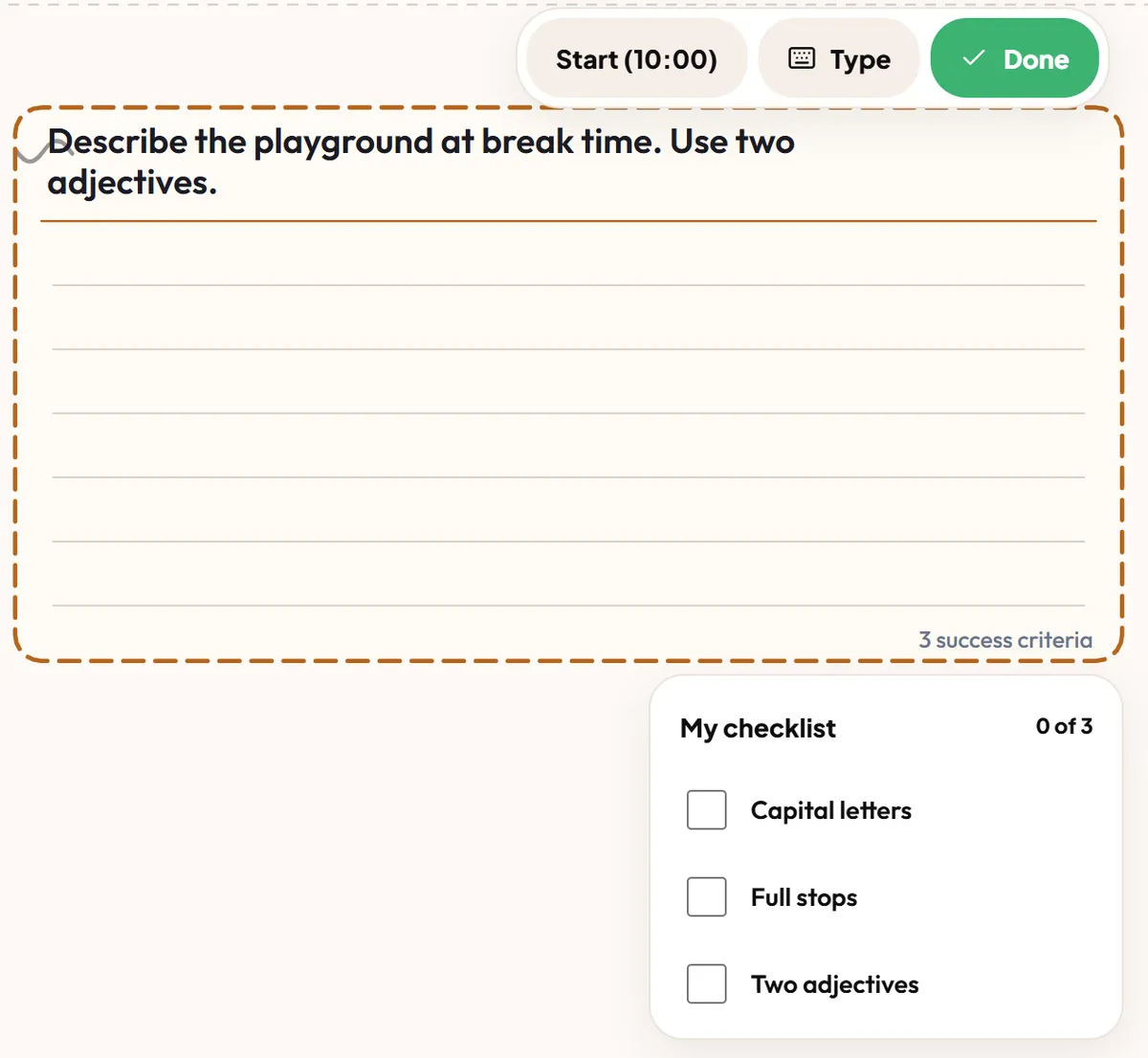
In Jotoro, pupils write in a writing box with a checklist of your success criteria and a timer, and can listen to what they have typed read back to hear where it trips. You see every child’s page live, so you can step onto Farah’s board while she writes and underline a sentence in red as she watches. Marking stamps and quick notes mean you do not have to type the same comment six times, and a pupil can send a piece to you when they are ready. The computer does not mark the writing: that stays with you, which is where it belongs.
How do you get the most out of your English lessons?
You do not need all five strategies in one lesson. A good English lesson usually has a small version of two or three of them. Here is a shape that works for an hour with most primary and lower-secondary classes, and shrinks well for a thirty-minute tutoring session.
An English lesson in five parts
- Sentence warm-up (5 minutes). Build, expand or repair two or three sentences.
- Retrieval (5 minutes). Last week’s spellings, a quick test with no notes.
- Read closely (15 minutes). One short text, one marking job, one discussion.
- Model and share (10 minutes). You write, then you write together.
- Write (10 to 15 minutes). A short timed write, with a word from you to every child while they work.
Keep a note of what you see: the sentence that tripped half the class, the word a child cannot yet spell, the clue three children missed. That list is your plan for next time, and it is more use than any mark.
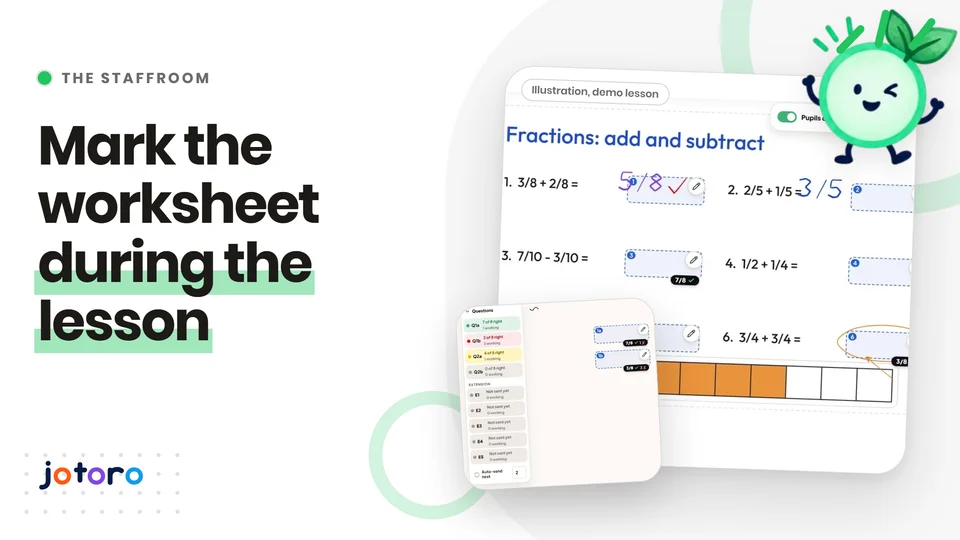
If you want to see the full set of English tools, read Jotoro for English, or look at the tools tray for the rest of the board. To check what children have understood while they work, see how to mark a worksheet during the lesson and marking and assessment. Close reading carries over to sources in other subjects: see history and geography teaching ideas. If you would rather build from your own texts, the Library keeps your lessons ready to use again. You can register interest to try Jotoro on your own worksheet, and plans and prices are there when you want them. There is a 14-day money-back guarantee.