Parents who teach at home often say the same thing: the lessons that work feel a lot like a good classroom lesson, only quieter. A clear start, something to try, a moment where the child shows what they know. The ideas below are the ones that make that happen, whether you teach one child at the kitchen table or a group of home-educated children at a centre.
How long should a home education lesson be?
Shorter than you think. A child working one to one does not need the time a class of thirty needs for everyone to settle, so a focused session on one idea can be quite brief. Think of a lesson as one aim, one explanation, one task and one check.
- Pick one aim. “Today we will add fractions with the same bottom number.” Not “fractions”.
- Explain in a few minutes. Then hand the pen over. A child learns more from doing a question than from watching you do ten.
- Stop while it is going well. A good short session beats a long one that ends in tears. Come back to it tomorrow.
- Swap the type of work. Writing, talking, drawing and moving about are all real learning. Mix them across the day.
How do you check a child has understood?
The classroom answer is the mini whiteboard: ask a question, everyone writes, and everyone holds up the answer at once. At home it is the same idea. Ask a question, count to three, and ask your child to show you the answer, not just say it. Saying “yes, I get it” costs nothing, and a written answer tells you the truth.
Pair that with the oldest habit in teaching: a worked example, then a try. Show one full example out loud, with the reasons. Then give a very similar one for them to do, then a slightly harder one. If they get the first wrong, go back to the example. If they get the second right, you can move on with confidence.
A simple lesson shape for one child or many
- Start with retrieval. Three questions from last time, before anything new.
- Teach one idea. One worked example, with the reasons said aloud.
- Try one. A very similar question, written down.
- Show me. The answer on a whiteboard or page, all at once.
- Stretch or repair. A harder question for those who are ready, another example for those who are not.
- Note it. A line about what you saw, for next time.
How do you teach children of different ages together?
Mixed ages are a real strength of home education, and a real headache for planning. The trick is to share the topic and not the question. Everyone is thinking about the same idea at the same time, but each child answers at their own level.
Take the water cycle. The youngest labels a simple diagram. The middle child explains what happens to the puddle. The oldest writes a short paragraph using the word “evaporation” and says why the cycle matters for farming. You teach the opening together, then work the room, spending a few minutes with each. Because the topic is shared, you only plan once, and the younger child hears words that the older one is using.
Keep one small habit: when a child finishes early, they have something ready to do, such as a harder question, a drawing to explain, or a page to read. Early finishers who have nothing to do tend to start another conversation.
How do you keep a record of progress at home?
You do not need a complicated system. A dated page of work, a short note after each session and a list of what you have covered will do. What you are looking for is a pattern: what keeps coming up as hard, what has become easy, and what your child could do last month and cannot do now.
If you ever need to show anyone what your child has been learning, such as a new tutor or a centre, that simple record is far more useful than a memory. It also makes it easier to see when it is time to move on.
How can a parent use Jotoro for home education?
Jotoro is a whiteboard built by teachers, and it is designed to save you planning time without cutting corners on teaching. Here is how a parent can use it efficiently when their child is on their own device, in the same room or another one.
- Plan from your own Lesson Library. Save lessons in folders and reuse them. Import a PDF you already have, such as a worksheet or a page from a workbook, and it opens as a board you can write on. A 60-page PDF opens in seconds.
- Answer boxes that mark themselves. Put an answer box on any question and enter the right answer. Your child types or taps theirs, and it is marked as they go, so you are not marking at the end of the day.
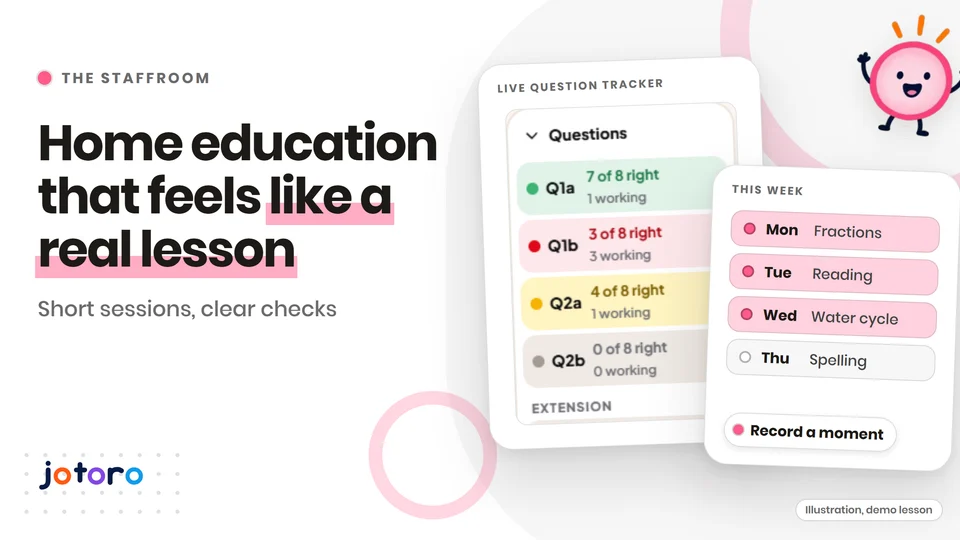
- Watch the live question tracker. A slim strip shows each question and how it is going. With more than one child, you see at a glance which question is tripping them up.
- A full track record for each child. Results and a timeline are kept for every child, so the record builds as you teach.
- Record a lesson moment to rewatch. Press Record while you explain, and your child can watch the replay again later. It is the explanation you do not want to repeat three times.
Jotoro works wherever the children are. A child can join from another room or another house with the class link, and homework can be done from home too. Homework itself is set, handed in and marked online.
How do tuition centres run home education groups?
Some tuition centres run daytime groups for home-educated children, often with a mix of ages in the same room. It is a good fit for a whiteboard that shows every child at once.
- Mixed ages, one topic. The tutor opens a shared topic on the board, then gives each child questions at their own level.
- Class link and waiting room. Each group has a permanent class link. Anyone unexpected waits in a calm waiting room and sees nothing of the lesson until the tutor lets them in.
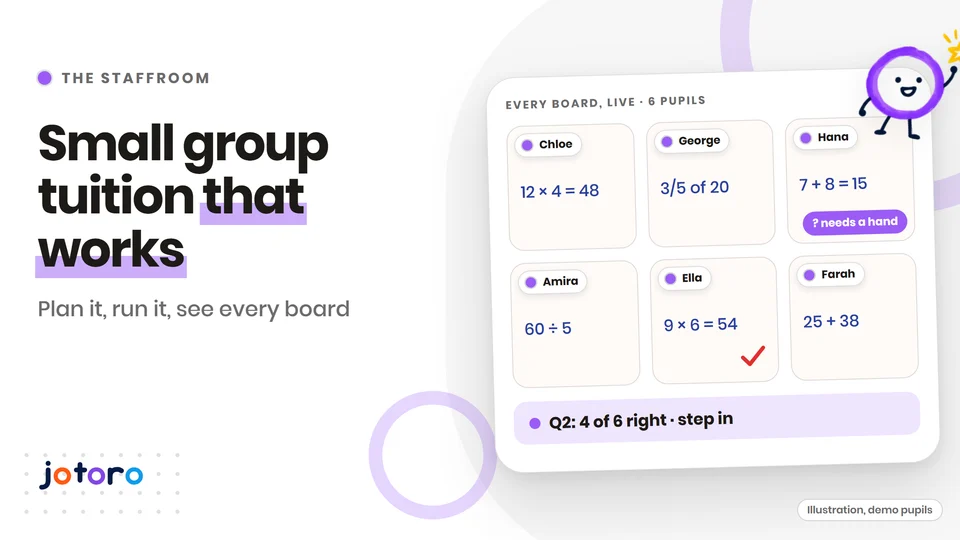
- Every child’s own board on the tutor’s screen. The tutor sees all of them, and can step in with the child who has stalled without stopping the rest.
- The live question tracker. It shows how each question is going, so the tutor knows which idea to revisit with the whole group.
- Extensions for early finishers. Send a harder question to a child who has finished, so nobody waits.
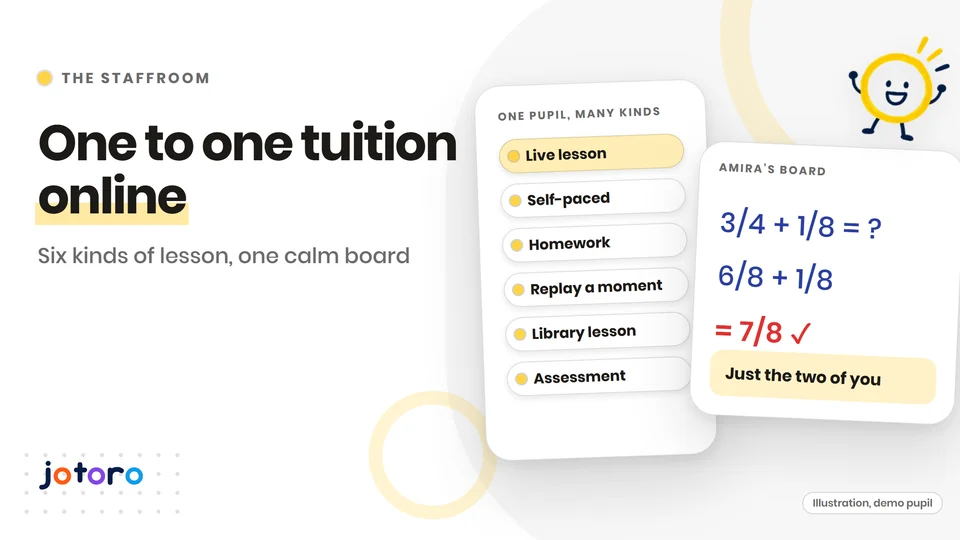
All of this works with the children in the room or joining from home. If you run a centre, Jotoro for tuition centres shows how groups, classes and registers fit together, and small group tuition goes through the planning in more detail.
How do you get the most out of your lessons?
These habits work in any home education lesson, with or without Jotoro.
Six habits for better home education lessons
- One aim per session. Say it at the start, check it at the end.
- Ask for a written answer. It tells you more than “I get it”.
- Teach one example, then try one. Keep the two very close.
- Open with last time. Three questions bring back what was learned.
- Share the topic, vary the question. That is how mixed ages work together.
- Write a line afterwards. What was easy, what was hard, what next.
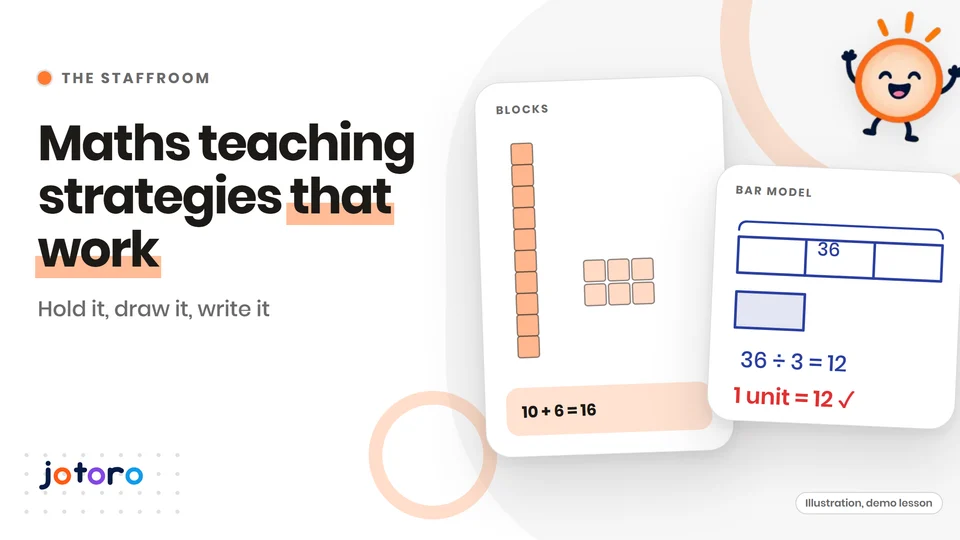
The same checking habits are at the heart of maths teaching strategies, and one to one tuition looks at what a lesson for a single child can do. You can register interest to try it. There is a 14-day money-back guarantee, and plans and prices are there when you want them.