Why do children need to move things before they write them?
Dev can say “ten tens make a hundred”. He can even write it. Then you ask him to take 28 away from 143 and he lines the digits up wrongly, because the digits are only shapes to him. Ask him to build 143 out of blocks first, one hundred, four tens, three ones, and the problem looks different. He sees that he has to break something to take 28 away.
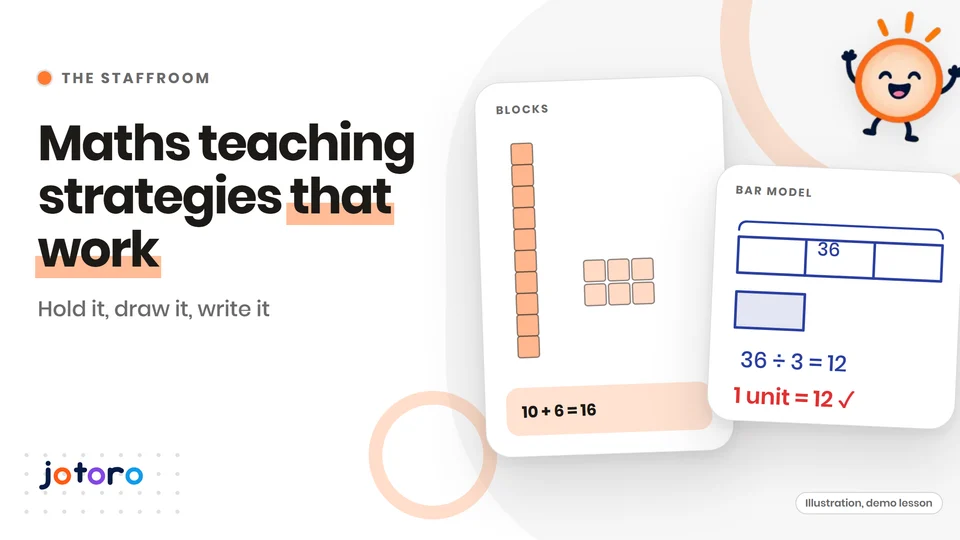
That is the point of moving from concrete to pictorial to abstract: touch it, see it, then write it. Children who skip the first step can still get answers right, but their method is fragile. A short time with blocks makes the written method hold. For the wider picture, see maths teaching strategies that work in any lesson.
How do you teach place value with Dienes blocks online?
Try this ten-minute sequence with a group of mixed confidence. Each child has their own set of blocks on their own board.
Place value in five steps
- Build it. “Show me 134 using as few blocks as you can.” Look across the boards. Spot the child who has 13 tens and 4 ones.
- Say it. Ask Chloe to explain her build to the group. “One hundred, three tens, four ones.”
- Change it. “Now take away 8.” A child with four ones cannot take 8, and has to break a ten into ten ones. Let them discover this. Do not tell them.
- Write it. Only now, write 134 − 8 = 126 and show how the exchange lives in the written method.
- Try a harder one. 203 − 47. This is where children who have only learned a trick fall apart, and where the blocks catch them.
Watch for children who count blocks one by one, children who forget the empty column in 203, and children who break the wrong block.
Why use a fraction wall to teach fractions?
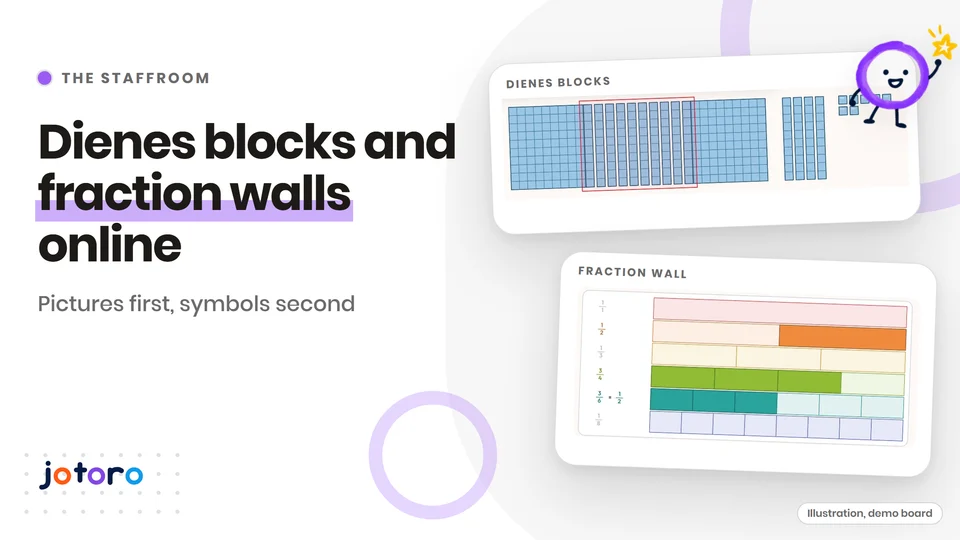
Fractions are the topic where “I don’t get it” appears most often, because children meet a number that is two numbers and a line. A fraction wall turns it into something you can compare by eye: a whole, a half, two quarters. Put them side by side and a child sees without being told that one half and two quarters are the same length.
- Start with the whole. “How many halves fit in one whole?”
- Line them up. “Put a half under two quarters. What do you notice?”
- Ask for a prediction. “How many eighths do you think will fit under a half?” Let Ella guess, then check.
- Find a pair that surprises. One third and one half: nothing lines up neatly, and that is the interesting thing.
- Write the equivalence. 1/2 = 2/4 = 4/8, and say why the numbers on the line change but the length does not.
Watch for children who think a bigger bottom number means a bigger piece, and children who see the wall as just “a lot of boxes” until you ask a question about it.
How do you keep everyone moving things, not watching you?
This is the main difference between a good online lesson and a screen share. If one person moves the blocks, everyone else is watching a video.
The simplest rule: send the same starting picture to everyone, and ask for something different from each person. Everyone starts with the same blocks, but the question is “build 134 your own way” or “make a fraction that is bigger than a half”. Then look across the boards and choose two to talk about.
It also helps to ask for the surprise on purpose. “Who has a different answer from the person next to you?” turns a right-or-wrong exercise into a conversation.
How does this work in Jotoro?
Jotoro has maths tools because pictures should come before symbols. The blocks, the fraction wall and the rest are on the board, ready to use. You can send any of them to pupils as a ready-made starting point, and you see every child’s board live while they work. That is how you spot the child with 13 tens before they have written a wrong answer.
You can see how it all fits together in the live classroom, and build your own starting pictures and lessons in create. For more ways to use a shared screen, see interactive whiteboard ideas for the classroom.
What mistakes will you see?
- Counts blocks one at a time. They have not yet trusted tens and hundreds. Ask: “How could you see that without counting?”
- Makes 13 tens and 4 ones. They have not grouped into a hundred. Ask: “Can you swap some of those for a bigger block?”
- Forgets the zero in 203. They treat columns as optional. Ask: “What is in the tens place? Show me.”
- Says a quarter is bigger than a half. Larger bottom number, larger piece. Ask: “Put them next to each other. Which is longer?”
- Gets the answer but cannot say why. They have a trick, not an idea. Ask: “Show me with the blocks.”
When do you move on to symbols?
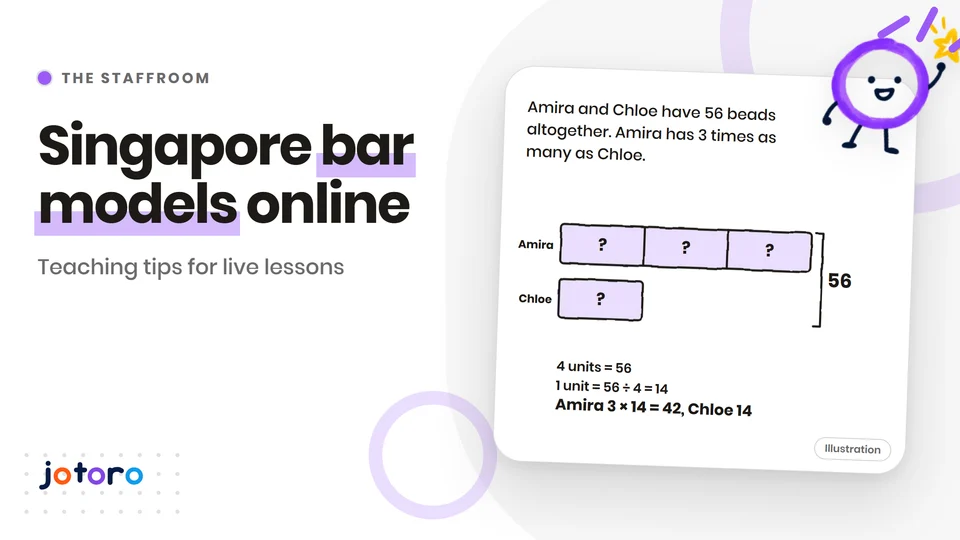
When the child can explain the picture without you. Not before. A good test is to ask them to teach it to someone else: if Farah can explain to George why you need to break a ten, she is ready to write the sum. Then go back to pictures when a new idea appears. A bar model is a natural next picture for word problems: see Singapore bar models online.
You can register interest to try all of this, and plans and prices are there when you want them. There is a 14-day money-back guarantee.