What is a bar model, and why does it help?
Dev reads “Ella has 12 more than Dev” and writes 35 × 12. He has seen two numbers and grabbed an operation. A bar model slows that grab down. Before he calculates anything, he draws what the story says: a bar for Dev, a longer bar for Ella, and a small piece at the end for the “12 more”. The picture shows him it is an addition, and shows him what the question mark is asking for.
That is the heart of the Singapore method. The bar is not decoration. It is a way of seeing how the quantities in a story fit together: parts and wholes, one amount compared with another, one unit repeated several times. Once children can see that, the arithmetic is usually the easy bit.
How do you introduce bar models online?
The same way you would in the room: start concrete, then draw, then calculate. Use counters, cubes or anything on the table first, so children can move real things about. Then draw a bar for the same story, and only then write the sum. Online, you can use whatever the child has to hand: coins, pasta shapes, building bricks.
Two habits make bar models stick online in particular:
- Children draw, you narrate. If you draw every bar while they watch, you are the one doing the thinking. Draw the first together, then say “your turn” and give them a minute with a pen.
- Draw first, calculate second. Ask “What does your bar look like?” before “What is the answer?” Children who rush to the sum are the ones who need the bar most.
How do you teach a part-whole bar model?
Begin here, because it is the simplest picture: a whole, split into parts. One part is known, one part is the question mark, and the whole is a bracket over the top.
Tell the story, then ask three questions: What is the whole? What do we know about the parts? What are we looking for? The children draw the bar, label it, and only then write the number sentence.
Hana has 48 stickers. She gives 15 to Ben. How many stickers does she have left?
Ask the children to say the story back from the picture: “The whole bar is 48. This part is the 15 she gave away. This part is what she has left.” If they can do that, they understand the problem, whatever number they write next.
How do you teach comparison and “times as many” problems?
Once part-whole feels easy, introduce two bars one above the other. Comparison bars answer questions like “how many more?” and “how many altogether?”. The key move is that the shorter bar is a piece of the longer one. Line the left edges up, so the extra piece is easy to see.
Dev has 35 marbles. Ella has 12 more than Dev. How many marbles do they have altogether?
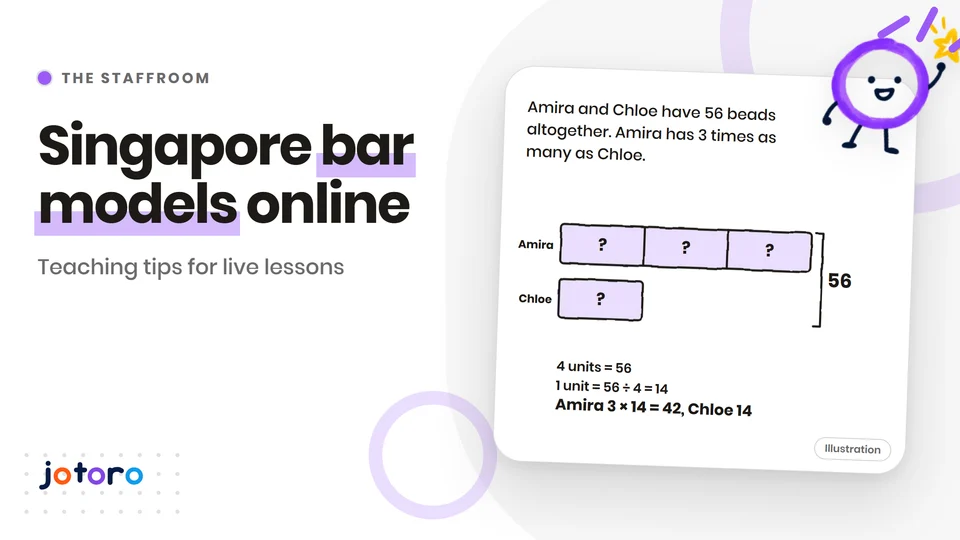
“Times as many” problems are where bars really earn their place. The unit is the hero: every bar is made of equal units, and the problem tells you how many units each person has.
Amira and Chloe have 56 beads altogether. Amira has 3 times as many beads as Chloe. How many beads does each girl have?
The question mark is still there: finding the value of one unit is the whole problem. Ask children to say “one unit is…” before they write anything. That sentence is where the thinking happens.
Teaching a bar model: steps
- Read the story once, then ask: what is the whole, what do we know, what are we looking for?
- Draw the bars. Keep the units the same size.
- Label every part, and put a question mark where the answer goes.
- Say the story back from the picture.
- Only now, write the number sentence and work it out.
- Check the answer against the picture: does it fit the bar?
How do you check every child’s bars in a live lesson?
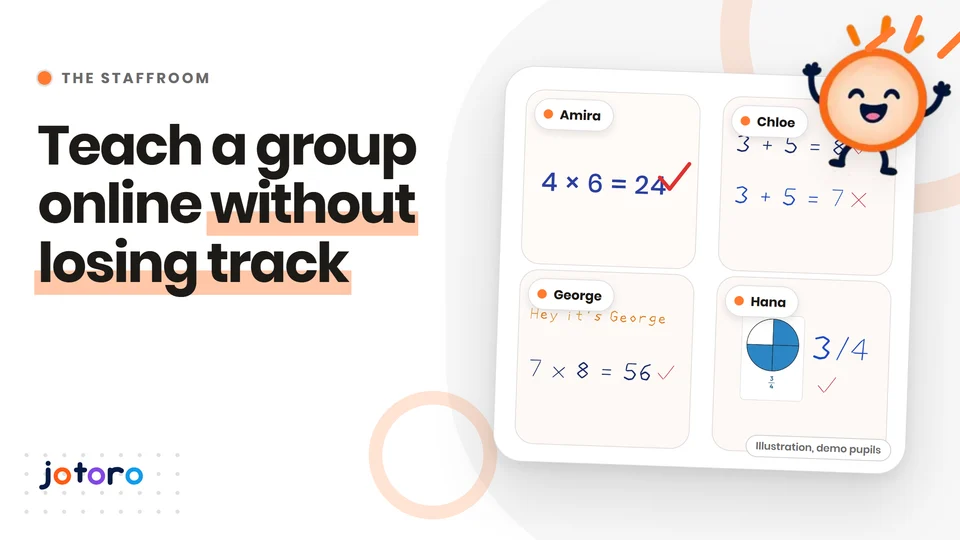
This is the part that is hardest online, and the part that matters most. The wrong bar is the whole problem: if a child draws Ella’s bar shorter than Dev’s, no amount of tidy arithmetic will rescue them. You want to see the bars while they are being drawn, not after the sum has been done.
So change the order of your lesson. Read the story. Say “draw only the bar, no numbers to work out yet”. Give them a minute. Then look at every child’s bar before anyone calculates. You will spot the wrong ones in seconds: unequal units, a missing question mark, a bar for the wrong person. A quick word on their own page, a different-coloured line to show where a unit should end, and they are back on track.
If one child draws something particularly clear, ask if you can show it to the others. Children often pick up a classmate’s clear bar more readily than yours.
Which mistakes should you expect?
- Uneven units. The units are different sizes, so the picture lies. Ask: “Are these two the same? Show me.”
- No question mark. Children draw the bars but forget to show what they are looking for. Ask: “Where is the answer in your picture?”
- A bar for the wrong quantity. A common one is drawing the “12 more” as its own bar. Ask them to read the sentence again and say which bar it belongs to.
- Jumping to the sum. You will see the answer before the bar. Ask: “Show me the bar first, then convince me.”
- Stopping at one unit. In “times as many” problems children find a unit and forget to multiply back. Check the answer against the bar: does 14 fit into Amira’s three units?
The picture makes each of these mistakes easy to see and fix.
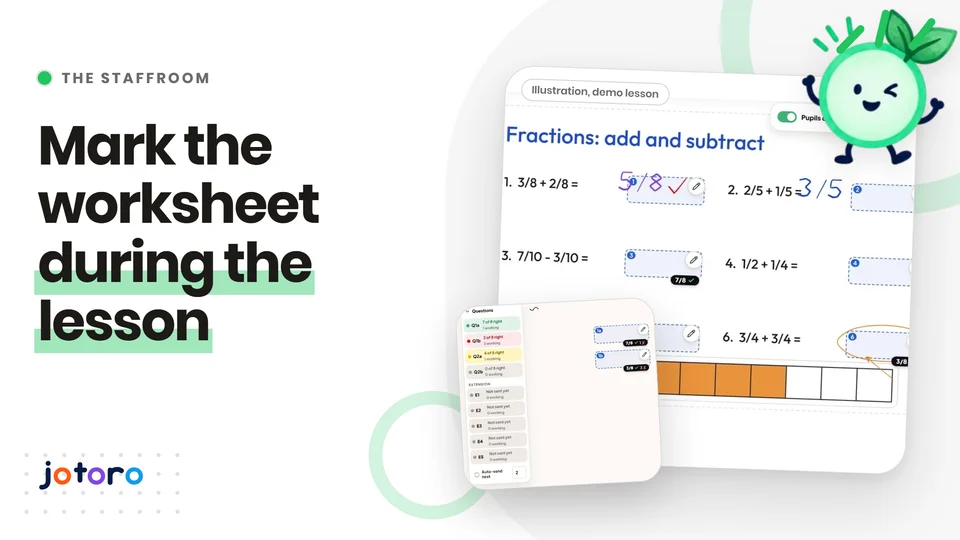
If you are teaching a group, how to teach a group of children online has a routine for scanning every child’s page, and how to mark a worksheet during the lesson covers checking answers as you go. You can register interest to try Jotoro for maths and see plans and prices any time. There is a 14-day money-back guarantee.