Where the evening goes
It is Sunday, and there are eleven pieces of homework waiting. You open the first one and read it all, line by line, with a pen. By the fourth you are tired. By the eighth you are giving “Good effort” to everything.
The trouble is not that marking is hard. It is that every answer gets the same amount of attention, whether it needs it or not. A sum with one correct number does not need ten seconds of your thought. A paragraph where a pupil has half-explained a method does.
Here is a way to give each kind of answer the right amount of attention, and a short evening.
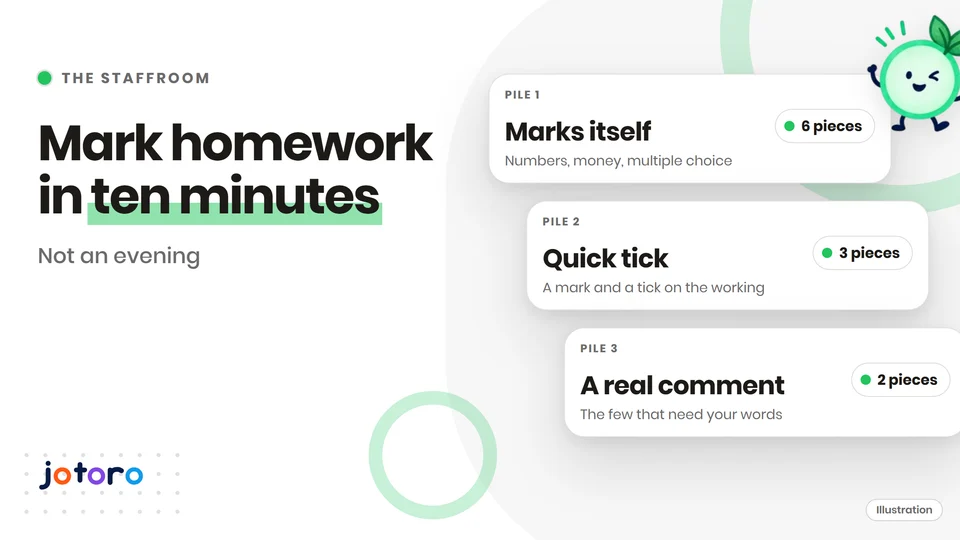
Pile one: answers that mark themselves
Look at what you set. Which questions have one right answer? A number, a fraction, a word, a unit, a choice from A to E.
These do not need you. If your tool can mark them as pupils hand in, let it. If it cannot, you mark them first, at speed, with an answer key beside you, and you do not stop to think.
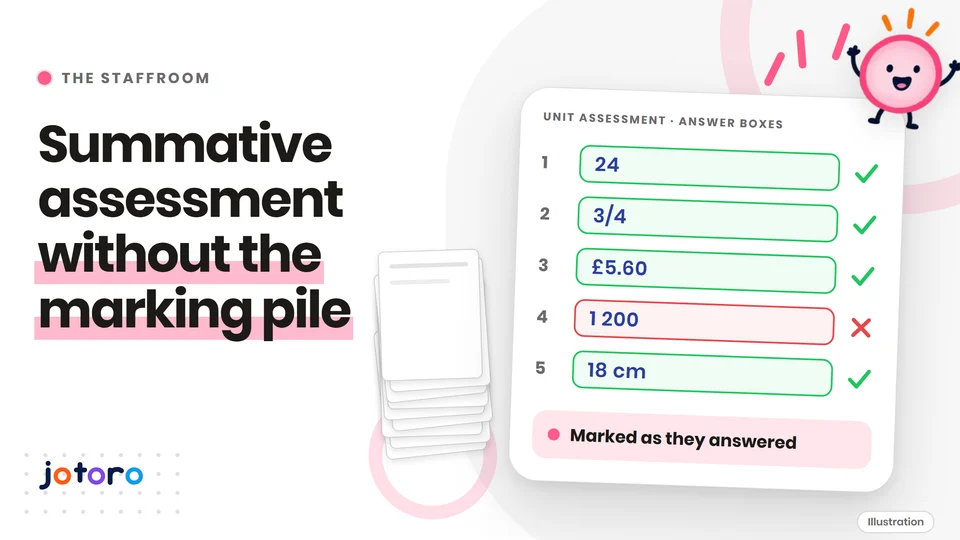
The aim is that pile one costs you no time at all. In Jotoro, you drop an answer box on each question when you set the homework, and each box marks as the pupil hands in. When you open the homework, the ticks and crosses are already there.
Pile two: quick marks for working
Next, the questions where the answer matters but so does the working. A three-mark long division is the classic example.
Do not read every line. Look for the one step where it usually goes wrong, and award the marks for the steps you see. Ben gets two out of three. A tap, a tap, done.
The trick is to decide before you start what each mark is for. One for setting it out, one for the method, one for the answer. If you have decided that in advance, a mark takes two seconds, not twenty.
In Jotoro you give the question three marks, tap the mark pill twice for Ben, and his total updates by itself. One tap gives full marks.
Pile three: the few that need a real comment
Now the open questions. “Explain why.” “Describe what you notice.” These need you, and they deserve the time you saved on piles one and two.
Choose one thing to say. Not five. One thing that was good, and one thing to do next. A short, kind comment that a pupil reads is worth more than a page of red that they do not.
If you find yourself writing the same comment again and again, save it. A stamp that says “Check your units” is faster than writing it twenty times, and it is still your feedback.
Written work in an exercise book
Plenty of pupils prefer to do their working on paper. That is fine, and it is a good sign. Ask them to take a photo and add it to the homework, next to their typed answers.
Maria’s working is in her exercise book. She snaps it on her iPad. You open her photo beside her answers and mark it in red, at once, in one place. Nothing is lost on the way and nothing needs posting back.
Close the loop
Two small things stop homework from becoming a stack.
Set a deadline, and let it close itself. Work handed in at five o’clock is marked at five o’clock. In Jotoro, anyone who started is handed in for you at the deadline, and an empty box counts as zero. Nobody needs reminding to press a button.
Give a second chance. A pupil who gets it wrong on Thursday and understands it on Saturday deserves to try again. In Jotoro, once the deadline has passed, a pupil can press Practise and work on their own copy. You never see the scribbles, and the real result stays safe.
The ten-minute version
For eleven pupils, an evening like this looks like this:
- Open the homework and look at the status list, to see who has handed in. (One minute.)
- Skim the grid of answers to see which question tripped most pupils. (One minute.)
- Mark the working questions, pupil by pupil. (Five minutes.)
- Write a short comment on one or two pupils’ open answers. (Three minutes.)
If it is taking longer, ask which pile it is coming from. Nine times out of ten, it is pile three, and you can shrink it by setting fewer open questions next week.
“I think it’ll save a lot of time.”
Try it with your own homework
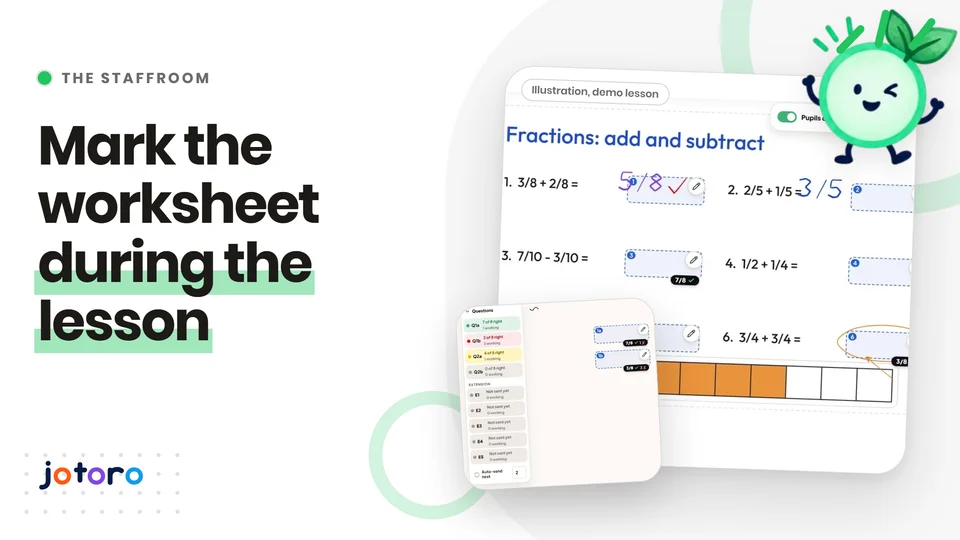
You can see how setting and marking homework works in Mark homework on the whiteboard. Marking while the lesson is still running is a different job; read how to mark a worksheet during the lesson. For end-of-unit tests, see summative assessment without the marking pile.
Payments are not open yet. Register interest and we will tell you the day they do. Pupils are always free.